

- This event has passed.
Kumbhathon Innovation S.P.R.I.N.T. 2026
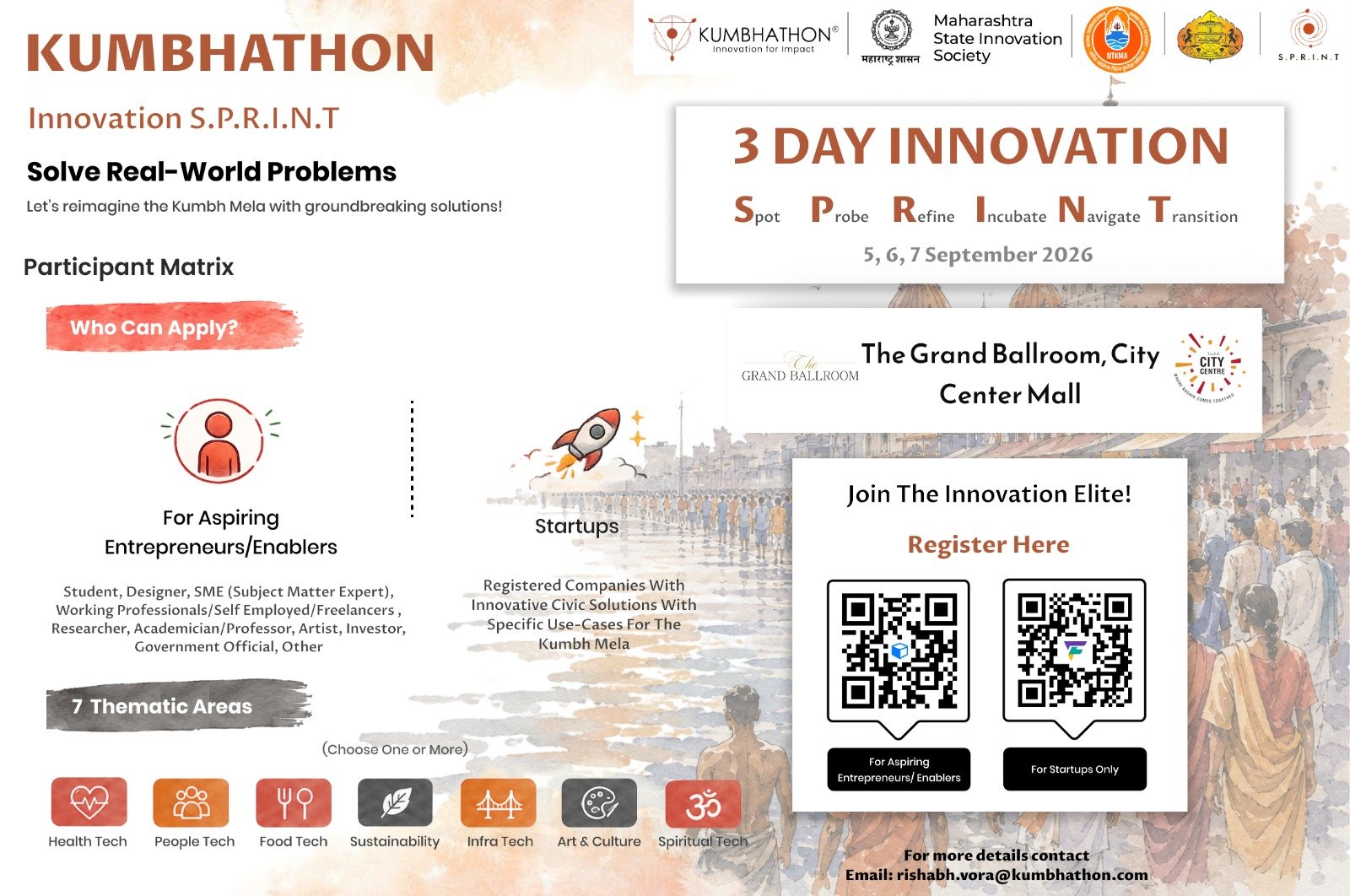
A City That Appears, Solves and Dissolves
The Kumbh Mela is often described as one of the world’s largest human gatherings. That description undersells what happens.
For a few weeks, Nashik becomes a temporary city. Sanitation, crowd movement, emergency healthcare, food distribution, waste management, public information, lost and found, transport, payments and identity all have to work at a scale no permanent Indian city faces on an ordinary day. Then the whole thing is taken apart.
Every system under stress there exists somewhere else under less stress. A crowd management model built for 100 million people applies to a railway station. A multilingual citizen information system built for pilgrims from twenty states applies to any government service. The Kumbh compresses a decade of urban problems into a few weeks, and solves them in public.
That is a laboratory. S.P.R.I.N.T. treats it as one.
Six Stages, Three Days
Kumbhathon’s method comes from the MIT model of civic innovation: spot the problem where it lives, probe it with the people who face it, then grow and deploy what survives. S.P.R.I.N.T. is that arc, compressed.
- Spot — Identify a real problem in the Kumbh context, grounded in observation rather than assumption.
- Probe — Test that problem against the stakeholders who live with it. Officials, vendors, health workers, operators.
- Refine — Sharpen the solution through mentoring, technical review and hard questions from people who have shipped before.
- Incubate — Build. Concentrated development on a project you already started.
- Navigate — Map the path from prototype to the real world. Regulation, procurement, partnerships, funding.
- Transition — Move from event to deployment. Pilots, incubation and continued support past 7 September.
Who This Is For
S.P.R.I.N.T. is deliberately not an engineering-only hackathon. Solving a public systems problem takes people who build, people who design, people who research and people who commercialise. All four are in the room.
Who comes
- 70% Young Innovators — students, researchers, working professionals, designers and aspiring entrepreneurs
- 30% Startups — early stage teams with a product already in market or in testing
How they build
Vertical tracks: AI / Software · Product / Hardware
Horizontal tracks: Design / Experience · Research / Policy · Commercialization / Entrepreneurship
What they build for
Health Tech · People Tech · Infra Tech · Food Tech · Sustainability · Art & Culture · Spiritual Tech
Come With Something Already Started
S.P.R.I.N.T. is not a blank-page hackathon. Applicants are expected to arrive with a project already in progress and build further on it across the three days. Three days is enough to sharpen and validate a real thing. It is not enough to invent one from nothing and have it survive contact with a stakeholder.
Every applicant needs:
- An idea or project mapped to at least one of the seven themes
- A clear view of which Kumbh problem area you want to work in
- A proposed solution to a specific challenge, not a general interest in the topic
Additional evidence by track:
- AI / Software and Product / Hardware — the problem you are solving, your current solution, what you have validated, what users told you
- Design / Experience — a portfolio of prior work
- Research / Policy — a research paper you have written, or a research brief on a Kumbh-related problem
- Commercialization / Entrepreneurship — credentials showing evidence of building
The Three Days
Day 1 — Spot and Probe. Opening addresses. Challenge statements presented by government and industry partners. Stakeholder consultation sessions where teams test their assumptions against the people who face the problem.
Day 2 — Refine and Incubate. Concentrated build. Table-side mentoring throughout. Technical review checkpoints and domain expert consultations.
Day 3 — Navigate and Transition. Startup-facing programme. Structured mapping between participant projects and attending startups. Pitching before investors and stakeholders. Sessions on pilots, procurement and pathways to deployment.
This Is the Fifth Time We Have Done This
S.P.R.I.N.T. is not a first attempt. Five prior programmes built the method, the network and the stakeholder access it runs on.
- Buildthon, August 2024 — two days, student focused. AI tooling, table-side mentoring, keynotes from business and government leaders.
- Kumbhathon Startup Festival, January 2025 — three days. Stakeholder consultations producing pilot opportunities, domain expert sessions, design thinking workshops.
- Kumbhathon Startup Festival, August 2025 — one day. Investor pitching, show and tell, one-to-one mentor consultations.
- Godavari Impact Conclave, February 2026 — hackathon and startup showcase themed on sustainability. 400+ participants across 40+ colleges.
- Claude Impact Lab, June 2026 — India’s first, run with Anthropic. A single problem statement: lost and found at Kumbh scale.
Organised By
Kumbhathon Innovation Foundation — a Section 8 non-profit and MSInS-recognised incubation centre based in Nashik, working across civic technology, startup incubation and government collaboration.
Nashik Trimbakeshwar Kumbh Mela Authority (NTKMA) — the administrative authority responsible for Kumbh Mela planning and execution in Nashik and Trimbakeshwar.
Maharashtra State Innovation Society (MSInS) — the Government of Maharashtra body driving startup and innovation policy across the state.
Apply Now
Apply as a Startup: https://founderboard.io/apply/kumbhathon-innovation-s-p-r-i-n-t
Apply as an Aspiring Entrepreneur/Young Innovator: https://kumbhathon.accubate.app/ext/form/23989/1/apply